It’s always hard to get back to the page, especially when our writing routine has been periodically interrupted over a long stretch of time. If writing is a way of reconnecting with oneself, not having anything to say feels like a terrible kind of muteness. Like a traveler eager to book a hotel room, we’re … Continue reading
Filling the Form: Why Being an Artist is About Baby Steps, Not Large Leaps
Filling the form. Julia Cameron, creativity expert and spiritual guru behind the smash hit The Artist’s Way, defines filling the form simply as doing our daily work: “What do I mean by filling the form? I mean taking the next small step instead of skipping ahead to a large one for which you may not be … Continue reading
Writing as Seduction
French-Russian novelist Francine Du Plessix Gray always begins her writing classes by asking students to compare the following sentences, the first from Nabokov’s memoir of his youth in pre-Revolutionary Russia, Speak Memory, the second from Agee’s Let Us Now Praise Famous Men. “She turned on the steps to look back at me before descending into a jasmine-scented, … Continue reading
Originality or Authenticity?
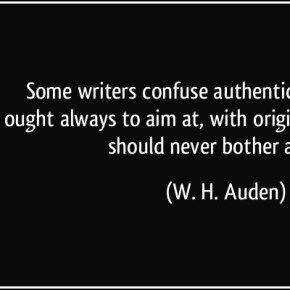
As I focus more on my writing, I find myself more concerned with whether or not my work is original. Reading my writing, I see the glaring marks of other authors: the figurative language of Plath, the gorgeous but conversational musings of Anais Nin. I turn to my blog and I see most of my … Continue reading
Productive Idleness: Why Play is More Important than Discipline to Creativity
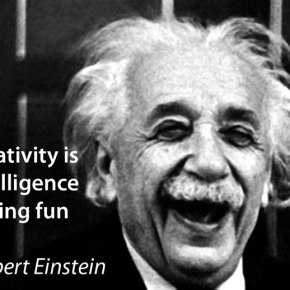
“‘It must take so much discipline to be an artist,’ we are often told by well-meaning people who are not artists but wish they were. What a temptation. What a seduction. They’re inviting us to preen before an admiring audience, to act out the image that is so heroic and Spartan-and false. As artists, grounding … Continue reading
How Journaling Can Help You Rewrite the Movie of Your Life
e.e. Cummings once said that “to be nobody but yourself in a world which is doing its best—night and day—to make you everybody else means to fight the hardest battle which any human being can fight; and never stop fighting.” Journaling is the greatest bulwark in this battle. Writing and reading, everyday, is how … Continue reading
Why Artists Need the Censor
In her groundbreaking guide to writing and creativity, Dorothea Brande argues that the logical left-brain is just as crucial to creation as the irrational right: “So, for a period, while it’s useful to you, think of yourself as two-persons-in-one. There will be a prosaic, everyday, practical person to bear the brunt of the day’s encounters. … Continue reading
Clutter is the Disease of American Writing
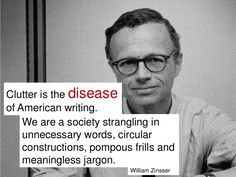
“Clutter,” argued William Zinsser, “is the disease of American writing. We are a society strangling in unnecessary words, circular constructions, pompous frills and meaningless jargon…Our national tendency is to inflate and thereby sound important. The airline pilot who announces that he is presently anticipating experiencing considerable precipitation wouldn’t think of saying it may rain. The … Continue reading
Art for Art’s Sake
Yesterday was a productive but frustrating writing day. I must get out of the habit of looking to other writers for examples. Yes, it’s helpful to look to other writers as a guide but-when you’re thinking about submitting to a publication-it can be creative suicide. Suddenly, we’re writing for a market, tailoring our ideas and … Continue reading
Desire Precedes Aptitude
What does it take to be forever immortalized amidst literary gods: talent or motivation? Though our culture often emphasizes the significance of innate talent, I am here to debunk that popular myth once and for all. Determination-the sheer inextinguishable will to get things done- is (and always will be) the better predictor of success. Desire precedes … Continue reading